
Use Cases
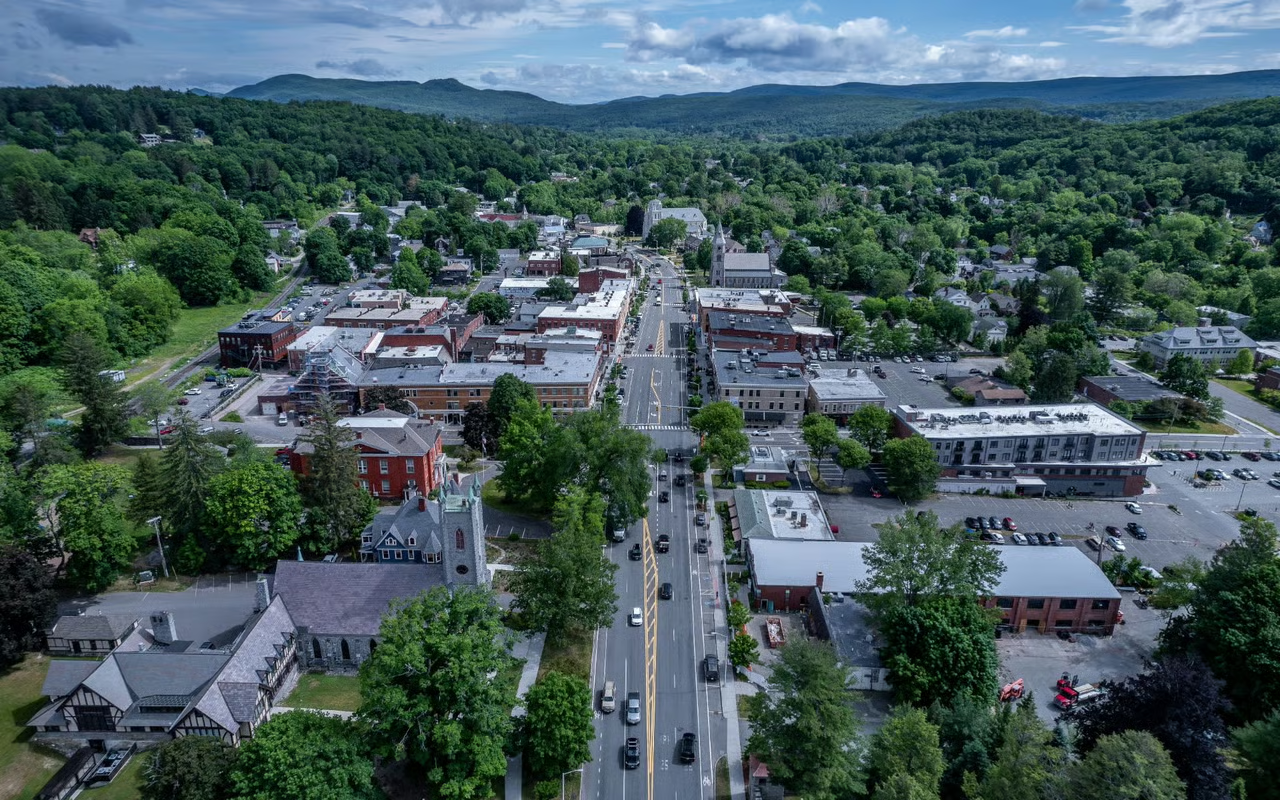
Berkshire Regional Planning Commission
About: Berkshire Regional Planning Commission (BRPC) is the regional MPO serving 32 municipalities across Berkshire County, Massachusetts. It's a large, rural network of communities with real transportation safety needs and little-to-no in-house engineering staff for a small planning team responsible for coordinating safety work across the entire county.
Challenge: BRPC launched its Vision Zero initiative with strong public commitment, built on a consultant-produced dashboard and High Injury Network. Keeping that foundation current took real lift: crash data from MassDOT IMPACT, roadway GIS and local context required manual downloading, organizing, cleaning before any analysis could begin, and refreshing the HIN or the predictive model meant re-engaging outside consultants. Sustaining recurring safety meetings with local jurisdictions across the county was a separate challenge for a small planning team covering 32 municipalities. Sub-jurisdictions had no tools of their own to run safety analyses or produce grant-ready outputs, and staff couldn't do before/after countermeasure evaluations, corridor analysis, or equity-lens filtering without outside help.
Solution: Citian's CRASH automated the MassDOT IMPACT pipeline, so crash records are ingested, QA/QC'd, and analysis-ready without manual work. The High Injury Network now updates continuously and staff can filter by severity, mode, and equity lens. Pre-built dashboards cover Vision Zero tracking, HSIP network screening, SHSP emphasis areas, and Vulnerable Roadway Users, and an HSM-tied countermeasure recommendation engine ranks interventions by benefit-cost ratio so planners can defend prioritization without engineering staff on hand. BRPC is rolling the platform out to all 32 municipalities, giving local staff their first independent way to query crash patterns and generate their own outputs, and extending the MPO's reach as a regional resource for safety analysis. Fact sheets and dashboards pulled straight from live data now support task force meetings, council presentations, and grant submissions, strengthening HSIP and SS4A competitiveness across the region.
“Citian's CRASH gives us a live picture of where risk is concentrated across the county, so we can focus our attention without taking staff time from other projects. It’s what lets us keep Berkshire STEPS up to date and grounded in real data for residents and municipal partners.”
— Nicholas Russo, Senior Transportation Planner, Berkshire Regional Planning Commission


Oklahoma Department of Transportation
About: The Oklahoma Department of Transportation and the Oklahoma Highway Safety Office jointly oversee statewide roadway safety planning, engineering analysis, and federal reporting across Oklahoma’s diverse network of urban, rural, and tribal jurisdictions. To access federal safety funding through programs such as the Highway Safety Improvement Program (HSIP), the agencies must produce defensible, repeatable safety analyses across decades of crash history—work that is traditionally slow and resource-intensive when data must be manually compiled, reconciled, and validated from disparate systems. Safety professionals across the state require timely and accurate data to accelerate funding justification and focus resources on proactive, newly data-defined safety projects.
Challenge: For decades, Oklahoma’s crash records were scattered across five disconnected datasets, representing 28 years and more than 2.2 million crashes–handwritten reports, image files, legacy digitized records, modern e-crash submissions, and supplemental datasets—that had never been successfully fused since reporting began, resulting in major inconsistencies and more than 140,000 duplicate records. This resulted in laborious and time-consuming internal processes. All fatal and serious injury reviews required manual inspection; HSIP evaluation took weeks; and public transparency and inter-agency coordination became exceedingly difficult for staff.
Solution: Oklahoma partnered with Citian to unify crash data that had been spread across five disconnected sources. Using CRASH’s AI-driven ingestion and refinement engine, Citian digitized paper reports, extracted data from images, reconciled conflicting entries, and eliminated duplicates, giving the state its first clean, fused, authoritative crash database. This new, single source of truth allows for advanced, automated safety analysis, including automated HSM-based evaluations, predictive risk modeling, and countermeasure effectiveness assessment. This unified database allows real-time data sharing across public works, police, and planning departments statewide, creating major efficiency gains and improving inter-agency transparency and coordination - powering long-term, proactive safety strategies.


Town of Cary
About: The Town of Cary is one of North Carolina’s fastest-growing municipalities, with a community that expects responsive, data-informed local government. Cary’s transportation division covers a wide range of responsibilities: signal operations, safety analysis, traffic calming, and multimodal programming. The team is lean by design, and the workload is not.
Challenge: Crash data was available, but onerous to pull together. Traffic records required manual review before staff could act on them. That slowed responses to public inquiries, obscured true safety conditions, and made it harder to identify emerging issues across the network. Meanwhile, the volume of work kept growing while the team did not. Getting data into a usable form for warrant analyses, citizen inquiries, and capital programming took more time than the department could consistently afford.
Solution: The operational impact was immediate. Signal warrant analyses that once took hours now take minutes. With roughly two dozen analyses completed each year, that time savings compounds quickly. Staff can respond to questions from residents and council members in real time, with confidence. The platform became part of daily operations: triaging 311 concerns, supporting all-way stop warrant reviews, and guiding Cary’s newly restructured Multimodal Improvements Program.
That speed is built on a trusted data foundation. Automated validation and correction eliminates mislocated and miscoded crashes before analysis begins, and high-precision geospatial analysis reveals true intersection-level safety patterns without manual review.
By analyzing crash frequency alongside crash rates, the team moved beyond simple hotspot identification to a prioritization approach that separates genuine risk from statistical noise. That methodology led directly to a capital project at an intersection adjacent to the municipal building that would never have surfaced under the old process.
“We’re a lean team, and this platform lets us punch above our weight. I’ve had it open in the middle of council meetings. It changes how you show up for those conversations.”
— David Spencer, Transportation Engineering Manager, Town of Cary, NC


Madison, WI
About: As the city continued to see crashes resulting in severe outcomes, Madison Vision Zero, launched in 2020, strives to improve safety for everyone moving about the city, whether walking, biking, driving and riding transit; and to improve the identified high injury locations, all in an effort to prevent fatal crashes and severe injuries. Madison has the goal of making all its streets and intersections safer via ongoing improvements to infrastructure.
Challenge: Madison wanted to refine their data quality while being more proactive in their management of crash data, recommending specific investments, and monitoring progress.
Solution: CRASH reduces the time and cost needed for street safety analysis while deepening understanding of crash patterns and producing actionable insights for implementation. Gathering and analyzing accurate crash data using Al leads to improvements in city planning and safety outcomes on streets across the City. Citian successfully located 95% of crashes that were previously unmappable, and systematically corrected other issues with Madison's crash data.
The added digital layer allows Madison to work toward preventing more crashes by having complete crash data sets to analyze beforehand, data to make informed safety countermeasure decisions, and compelling visualizations to convey these insights. CRASH enables Madison staff to streamline safety analysis and planning, producing outputs to secure competitive grant funding.


Calvert County, MD
About: Calvert County’s roadway safety functions are housed across several departments, Public Works, Planning & Zoning, and the Sheriff’s Office, alongside various state and local partners who also support. This is a common operational structure for Counties across the US, where authority, data, and analytical capacity are often distributed rather than centralized. Safety planning, data management, engineering review, crash reporting, and public inquiries necessarily relied on separate systems and request-driven workflows that were dependent on external state systems and specialized intermediaries, rather than being directly accessible within County operations.
Challenge: For years, Calvert County struggled with circular internal discussions about safety performance across various areas of the County. The continued conversations rarely moved meaningful projects forward as a result of uncertainty over the severity of the safety issues, and from the absence of accessible, segment-level crash analysis to establish a shared evidentiary baseline.
As public agencies face increasing pressure to improve transparency, accelerate response timelines, and apply data more proactively across departments, this model has become increasingly limiting. To make safety data more immediately usable, Calvert County pursued an initiative to centralize both data and operational workflows related to roadway safety functions. As safety questions grew more complex and urgent, the County recognized the need to modernize this area of its operations to align with current safety planning and data management practices, including support for development of its 2026 Strategic Roadway Safety Plan, a safety data report that publishes roadway trends and guides critical investment decisions. The County had also experienced challenges sustaining engagement among traffic safety professionals across multiple departments and partner agencies and maintaining a consistent, shared mission. This highlighted the need for a more coordinated approach that could support ongoing collaboration and data-informed decision-making across stakeholders.
Solution:To address these challenges, Calvert County implemented CRASH as a centralized, cloud-based crash analytics and safety planning platform. CRASH replaced data sources stored in multiple, disconnected state databases and formats with a single, authoritative environment for roadway safety analysis.
Standardized crash and contextual data enabled network-, corridor-, segment-, intersection-, and school-zone analysis within one platform. Core use cases, including hotspot identification, trend analysis, corridor studies, and before-and-after evaluations, can now be completed quickly and consistently without relying on specialized staff or manual data requests. Staff now have the data and tools necessary to present clear, defensible insights to decision-makers and support improved safety outcomes across the County.
As Jessicca Gaetano, Planner III, Transportation, explains, “CRASH has been an invaluable tool for Calvert County in strengthening our approach to roadway safety. The software gave us clear, defensible insights into roadway segments and intersections that have challenged the County for decades, allowing us to prioritize needs and advance meaningful, data-driven projects.”
Designed for operational use across departments, CRASH provides interactive mapping, visual analytics, and exportable reports that transform raw data into clear insights. Ongoing collaboration with Citian ensures the platform remains aligned with County workflows and long-term planning goals, including their upcoming Roadway Safety Plan.


City of Helena
About: Managing assets can be time consuming, but with ADAPT, cities are able to identify problem areas 20 times faster, operationalize their assets, and make immediate improvements to their infrastructure. Through sound infrastructure management and investment, cities can strengthen accessibility for pedestrians, maintain ADA compliance, and proactively make streets safer for all users
Challenge: Maintaining safe and accessible transportation infrastructure for vulnerable road users and those with impaired mobility can be resource and time intensive for cities. Collecting accurate and precise data remains a challenge for local transportation authorities.
Solution: Citian used a detailed LiDAR scan of approximately 300 miles of City streets and leveraged ADAPT’s artificial intelligence to automatically extract over 40,000 assets and their related measurements. Sidewalks, bike facilities, curb ramps, curbs, gutters, signage, road cross slopes, road striping, and more were captured, evaluated, and used to populate the comprehensive digital twin environment. City staff are able to leverage ADAPT to generate data-driven insights, prioritize budgets and capital planning, develop dashboards to monitor performance, visualize their system comprehensively, and process work orders. Helena uses insights generated in ADAPT to invest equitably across their pedestrian network, closing sidewalk gaps and addressing compliance challenges in priority areas.

Transform Your Community with
Advanced Technology


